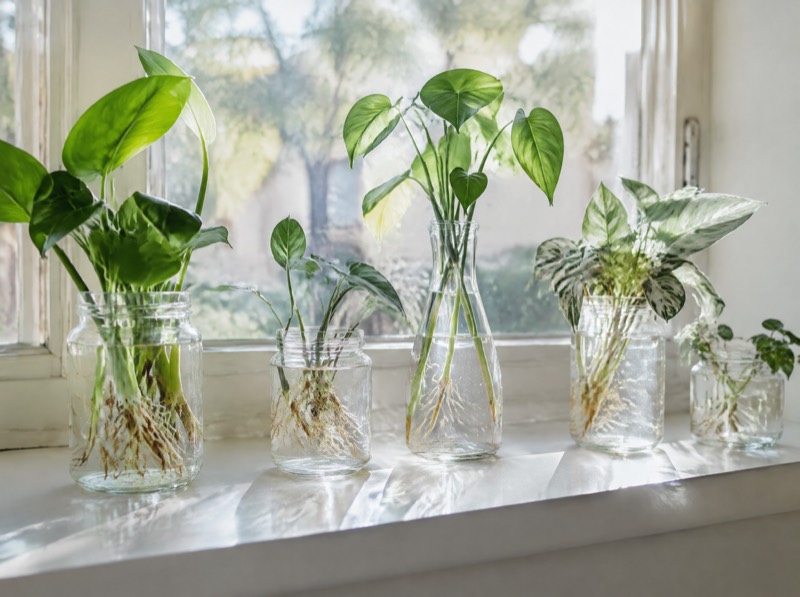
One pothos can furnish a flat. The simple methods for turning cuttings into plants, and the mistakes that make them rot.
Propagation is the most generous thing in houseplant keeping. A single healthy pothos can, within two years, become a dozen plants — for your shelves, your friends, and the colleague who admired the one on your desk. It costs nothing but a jar of water and a little patience.
The three easy methods
Water rooting is the beginner's friend: cut below a node, remove the lower leaves, stand the cutting in a jar of water, change the water every few days. Roots appear in two to four weeks. Soil rooting skips the jar: dip the cutting in rooting hormone if you have it, push it into damp compost, and keep it humid under a clear bag. Division works for plants that grow in clumps — peace lilies, spider plants, calatheas — simply split the root ball and pot each half.
Which plants propagate easily
Pothos, philodendron, monstera, tradescantia, spider plant, string of hearts, begonia — all root readily. Succulents prefer leaf or stem cuttings left to callous before planting. Woody plants and most ferns are slower and fussier; start with the easy list.
The mistakes that cause rot
Most propagation failures are water problems. Leaves left below the water line decay; water left unchanged grows algae and bacteria; compost kept soaking wet drowns the forming roots. Keep the water clean, keep the compost merely damp, and give the cutting bright but indirect light.
When to pot up
Wait until the roots are a few centimetres long and there are several of them. Moving a cutting too early sets it back; moving it too late makes it struggle to adapt. A healthy root cluster is the signal, not the calendar.
The gift economy
There is a lovely arithmetic to propagation: every cutting you root makes an extra plant you did not pay for, and the surplus becomes gifts. A windowsill of jars in spring is a small factory of generosity. Start with one cutting. You will not stop at one.